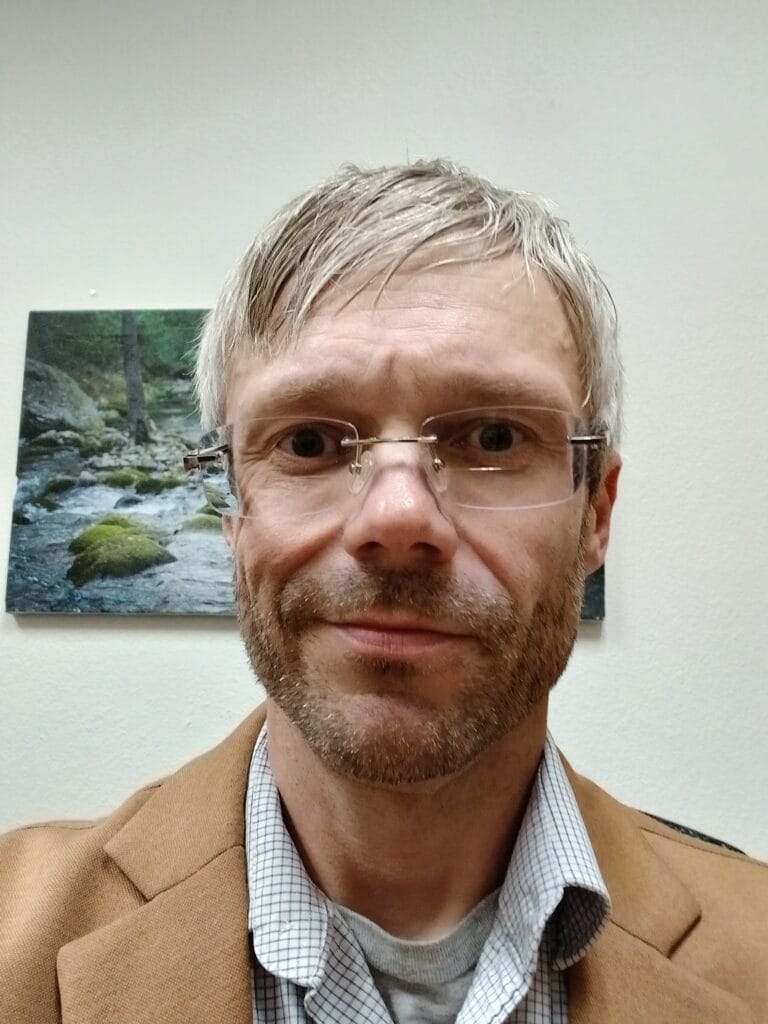
Richard Birken
Soft Hands
Richard Birken
Soft Hands
She told me my hands were so soft. My fingertips were soft. Like velvet, she purred. Did she think that’s what I wanted to hear? What about my happiness? What about my pride? The woman didn’t know me at all. She didn’t care about me at all. I could have been anybody. I got up, put my clothes on, and left. She never saw it coming. Too bad.
I walked to the end of the corner, to The Whistle Stop, and went inside. The bar was mostly empty. I sat at a stool, and ordered tequila, straight. Then another. Both went down the slot fast. Then I realized I had nothing more to do there. That’s the trouble with bars. Once you’re done drinking, there’s just the smell of cigarette smoke and vomit. And old perfume. I’m not one of those guys who can sit at a bar all day or all night and talk or just sit like I’m stuffed. Sometimes you just want to sit at a bar and cry in your soup, but that’s not really how it is.
So I paid my money and left. The tequila could have been water, for all it did for me. Tequila can’t roughen your hands, or your heart. It can’t change your head. It just washes over the works like a stream over stray pebbles, purposeless; it doesn’t even know the pebbles are there. I needed something to scrape away the pebbles, the crud, that had deposited in my brain between the useful stuff.
That’s when I heard a noise that sounded like a ball hitting a bat, hard. Then another time. That was all. I looked all around, but the sound had come from another block. I started to run, and that’s when it all hit me—the sex, the tequila, how out of shape I was. I was out of breath by the time I’d traveled two blocks. She was hunched over a scrabbly hedge, the tips of the spines turning dull red. For a moment I didn’t know what to do. I’d never seen anybody bleeding in the street before except from my window when I lived in the city. Not real blood, like this. I finally worked it out in my head, and pulled her off the hedge and laid her out flat on the sidewalk, face up. I looked up and saw somebody watching out of an open window. “Call an ambulance,” I yelled. “Call the police.” The face at the window hesitated, then disappeared.
The woman on the ground was still alive, her chest heaving up and down, but her eyes were closed. I knelt by her ear and whispered, “Don’t worry, help’s coming. You’re not dead.” I realized how stupid that must have sounded to a person who wasn’t dead. But what do you say in such a situation? You’re not at your best, not even close to it. So I shut my yap and waited for the police to come. It felt like I was sitting back at that bar, with nothing to do or say, just a statue of a man. Just waiting for the police to come or the starlings to crap on me. Even that would be better than watching the blood trickle out of the woman’s head onto the sidewalk.
Finally, the ambulance arrived, and the paramedics pushed me aside. Then the police arrived. Then the crowd arrived. Where did they all come from? I hadn’t seen anybody. Then again, I hadn’t been looking for anyone. Actually, I’d been thinking this whole time. I was somewhat distracted even when the police questioned me. Then it was all over, I had a date at the station with a detective, and nothing left to stare at but a stain on the sidewalk. I wasn’t even sure where my car was. So deep in thought that I couldn’t even remember what I’d been thinking about. Life’s funny—when the most is going on, nothing’s happening. The brain protects itself with all those pebbles and crud. And there’s no way that’s going to work.
I wasn’t much help at the station. The inside of my head felt like the Berkeley Hills looked in the misty morning. Berkeley. Funny to think about that. Another coast, another life. The small club, my ambitious hands. All I could tell the detective was the bleeding head, the sound of baseballs flying out of the park. I promised to get back to him if I thought of anything else. The way my life was going, I was lucky they didn’t just arrest me to get the case off the chalkboard. As I left the station, I noticed my right hand was shaking. I remembered a person at the bar, on a stool to my left. I remembered noticing that his right hand was shaking on the counter top. Probably the way I’d end up, too, if I kept on the way I was going.
When I got home to my castle, my efficiency, I threw my keys on the only bare space left on the counter separating the small kitchen from the small living room. The clocks—there are clocks everywhere now, flashing at the world as if time was controllable, on my range, on my stereo, on my DVD player—told me my Sunday was about shot. I took a beer from the fridge, tossed a dirty look at my guitar standing so pristinely in the corner of the room, laid down on the couch, and put on what was left of a football game. I was asleep before I got to half the beer.
When I awoke, the place was pitch black. The clocks flashed 9 p.m. That’s the only organized thing about my place—all the clocks are set to the same time. It took me years to learn how to set the damn things, and I’d be damned if I wanted twenty different times yelling at me. One was bad enough. Time is an enemy. When you’re young, time is all seconds and minutes, but now time went in days and nights. Daytime at work, nighttime at the TV or with a woman who just couldn’t understand anything. I’m the high maintenance type, but people got to figure out who a person wants to be. Not who they are, who they want to be. Because us “ordinary” people never meet the kind of people who are what they wanted to be. Us “ordinary” people think too much for that. When you’re twice divorced and have no kids and are over fifty, people oughta know that. I know that.
Thinking. That’s how you end up past nine not having eaten dinner yet and almost time for going to bed. I turned the TV off, put my jacket on, and headed out for a bite. I hated eating at home. I hated eating restaurant food all the time. I hated hating what I did, and I hated the guitar in the corner of the room.
Just before I got into my Mustang, I heard a car going too fast coming near. Some guy in a sweatshirt looked at me as he sped past. People also got to learn how to drive, I thought, as I started the car and tried to decide which one of my joints to eat at tonight. There are only a few places a person feels comfortable eating at alone, but still, a person’s got to choose.
The next day was Monday and I woke up groggy. Somebody was banging on the door. I put on a pair of shorts and answered the knock. It was the detective from the police station with some photos he wanted me to look at. I did my best, but I hadn’t seen anybody. I’d never looked at crime photos before. Everybody looked so sinister. Everybody looked so guilty. I could have picked any one of them and felt like a load had been taken off the world. I didn’t want to meet any one of those people if they really looked like that. Which I doubt. I’d probably look pretty mean and nasty in one of those photos. I’d pick myself out just to get me off the streets.
Obviously, I wasn’t much help to the detective. At least he said the woman was still alive. I hadn’t thought about that since yesterday. I’d thought more about my damned guitar than I’d thought about her. Which makes sense, really. That’s what I should be thinking about. I faced another day of work without passion, and I should be home with the guitar. For years, that’s where I should have been. Through two divorces, that’s where I should have been. I should have recognized one of those guys, too. The detective must have had some reason to choose those photos. One of the neighbors must have said something. Or maybe there was someone there and I just wasn’t alert. I haven’t been alert for years. That’s the guitar’s fault. But I had to go to work so I could pay the rent and the alimony.
The day flew by, as usual, and when I left work I was back in the night. As I left the building, a guy in a sweatshirt and baggy sweatpants almost bumped into me. It was going to be one of those kinds of nights. I went to a local dive that served cheap food and ate with the newspaper. The sports section made better company than that damned woman and my soft hands. I made the meal linger, the longer to stay away from home, but you can only shift food around on the plate for so long. I paid the tab, and drove home, tailgated all the way. One of those nights. The TV waited for me, and I watched it, despite the cold stares sucking on my forehead from the guitar in the corner of the room.
It was about 3 a.m. when I awoke on the couch to the screech of a car’s brakes. It sounded like the car had stopped right outside my front door. I realized I was on the couch and not in bed. Again. I heard the car again, screeching this time to movement and away. I got up to pee, stripped, and got into the bed to finish what I had started.
The next day, I had to call her. I felt like such a wimp, but I wanted company, woman company. Besides, I liked her when she wasn’t being dim. She didn’t know about the inside of an empty man’s head, and I guess that’s all the better for her. I never could explain how you’re supposed to treat somebody like me. And I know a lot of people out there are like me, life itself accusing them of something not followed through. There are only two kinds of people out there, the kind who think too much and the kind who think too little. I’m the kind who thinks he knows how many kinds of people there are out there, and because of that I was lucky there was any woman that wanted to share my piece of Earth. At least, that’s how I always looked at it.
We went to a small club to have a drink and listen to some music. I should have known better, but I keep going to clubs. There I sat, my stomach hurting, listening to somebody else but thinking about me. Then I had a thought that I wouldn’t have had if I had been paying attention. A face was looking at me intently. Not at the woman on the ground, bleeding: at me, at my face. I didn’t recognize the face, but I had seen it before. Funny how not being able to concentrate on music, my favorite thing to concentrate on and the thing I could least concentrate on, focuses the mind and the stomach. I needed another tequila, and I needed to get out of there. She didn’t understand that, and I didn’t explain it. I just wanted to get between the covers with her and bury my face in her love life.
I spent the next two nights at her place. That was the first time I’d done that. What could she see in me? She didn’t seem the desperate type. I hadn’t realized how badly I needed to be away from my place. I realized it when I went back to my place. It felt like returning to a haunted house. The street outside suddenly seemed foreign and gray. There wasn’t a cloud in the sky, but it must be raining to be so gray. It was as if somebody came and painted it while I was away. Or painted over the lenses of my eyes. I parked my car and went inside and locked the door.
The first thing I always noticed as I tossed my keys on the counter was the guitar standing in the corner, and so when I noticed it was lying on the floor I got thirsty quickly. I popped a beer bottle and took a long drink. I knew what was going to happen, and I was afraid.
I walked slowly toward the corner of the room while my brain cried out for the remote control. When I reached the damned thing, I bent down and righted the heavy case and opened it. The wood gleamed at me, the light shined my face into the mirror of the tender craftsmanship of the friend from long ago that had made it for me. I pulled the guitar gently, as if I still cared, from the case, and sat on the couch with it in my lap. Then I got up again, pulled a pick from the case, and sat back on the couch. I started playing softly, noodling, then started on a melody I had written years before. Somehow, I played well, smoothly. I closed my eyes and rocked a little on the couch and listened. When the car screeched outside, I realized I had been concentrating and listening for over an hour. My fingers howled with pain. Deep tread marks lined each finger of the left hand. Each tread mark was filled with dirt. I put down the guitar, took off my shirt, and rubbed each string lovingly up and down with the shirt rolled around my fingers.
The loud noise at the door didn’t surprise me. With the guitar still in my hand, I tiptoed to the window and drew the curtain slightly open. I couldn’t believe he had the same sweatshirt on, the same one he wore in the crowd that day, the same one he wore in the bar that day, the same one he wore in the car and when he bumped me and in the photograph the detective showed me. I walked to the door and pulled it open suddenly. The guy almost fell into the living room. The hand he held the gun in fell to his side as he steadied himself. “Don’t you have another shirt?” I asked him.
“I own the company that makes these,” he answered, as if we were just chatting at adjacent bar stools. The front of the sweatshirt had a picture of a dragon on it. Then I smashed the guitar against his head, over and over again. I kept smashing it on him even when he lay motionless on the ground, the gun having slid all the way into the kitchen. I kept smashing it on him even when I realized he was unconscious. I finally forced myself to stop. I dropped the guitar. My hands still shook by my side. I managed to make it to the telephone and called the police. Then I noticed the guitar, lying on the carpet, in ruins, and I started to laugh. I was still laughing, the laughing turned to crying but still laughter, when the police showed up at the door. I looked at my left hand, my soft fingers indented with deep ridges accented by dirt and a little blood, the hand still shaking slightly. That stopped my laughing. I looked at the body stirring on the floor. I stared hard at the guitar’s remains. Somehow I had time to remember a small club on a different coast, melodies swirling in my head. I looked again at my soft hands. Then I opened the door.
Richard Birken won the American Independent Writers’ Prize for Short Fiction for his first published story. A finalist for the Tobias Wolff Award for Fiction, his work has appeared in JuxtaProse Literary Magazine, The Raw Art Review, Breakwater Review, and The Adirondack Review. While he lives in Virginia, the UCLA and Berkeley graduate will always be a Californian at heart.

Featured in:
Red Rock Review
Issue 55