Allison BOTHLEY
Below the Waterline
Allison Bothley
Below the Waterline
There are a handful of ways to enter the ocean from a dive boat. You can jump feet first, bracing against the impact, scissor-kicking into the blue. You can descend the ladder, deliberate and careful, like a princess exiting a tower. Or, if you’re feeling brave—if you trust your body’s instinct for movement—you can do the backward flop, arms crossed over your chest, letting yourself freefall. If you look like a sea lion slipping from its perch, you’re doing it right.
My father dropped our mesh dive bag onto the dock. His Tommy Bahama flip-flops squelched against his feet. He stood with his hands on his hips, stomach protruding, a conqueror surveying his domain.
“Thar she blows,” he said, jutting his chin toward the approaching boat.
I squinted at the name painted across the hull: M’Lady’s Resolve. Dubious. The boat was ordinary enough, but it rocked and lurched in the swell like a drunk coed on a mechanical bull.
Scanning the dark corridors of my hungover brain, I searched for anything salvageable after two days of phoning it in at a resort pool. The dive training had been facilitated by the same bronzed man in a hotel-branded visor who, just last night, had made me a watery strawberry daiquiri, wearing a paper-thin smile.
“Isn’t diving better when it’s calm?” I asked, spitting into my mask and rubbing the fluid around with my finger like those around me. Fog prevention, apparently. A ritual of the initiated.
“Ah, this isn’t so bad.” My father pulled me into a side hug, his grip warm, familiar. “Been in swells ten times this wreck-diving the Great Lakes.”
He always said things like that, like his life had been one long, swashbuckling adventure. I knew the rhythm of all his stories by heart, the exact inflection of his voice when he told them. The way nostalgia sanded down the splinters.
“You’ll love it,” he said.
I used to adore these sojourns—the way he got inspired and just made things happen. He’d finish some money-making scheme, pocket his commission, throw up his arms in defiance of all responsibility, and just go.
For as long as I could remember, my father had been the focal point in every room. He sailed into a party and sopped up energy like a dry sponge fresh out of the plastic, always leaving with a half dozen new friends. I hadn’t inherited his charisma. I was my mother’s daughter—awkward, reserved, never quite knowing how to slot myself into the spaces he so effortlessly filled.
“Don’t tell Mom, Bug,” he’d say, winking as he signed blanket waivers and rental forms for us without reading the fine print.
A flick of the wrist, a nod to the instructor, and we were off—dangling from jungle canopies in Costa Rica, kicking up clouds of red dust on ATVs in Dakar, chasing the blur of the speedometer on the Autobahn. I learned early that hesitation meant being left behind. So, I kept up, matched his pace, said yes before I had time to think.
When our trips ended, I’d watch him speed away in his silver Audi and think this was how life should be. But back in my mother’s house, the dream wore off quickly while I waited for his phone calls, which came less and less frequently.
Eventually, the trips dwindled. I had a life of my own—or, I should have. And yet, here I was, hostage to the whims of a sixty-eight-year-old retired adrenaline junkie who lived and died by the notion that you’re only as old as you feel, while I felt old enough for both of us. The wanderlust was always his. I just wanted to be with him.
#
After months of silence, he called. And still, that stupid little kick of hope.
But the calls were different this time. Stilted. Almost careful. He asked about my job, about Paul—two things that had never particularly interested him.
“What’s new?” he said. “You seen your mother?”
“Yeah, I see her a few times a month for brunch and stuff.” It felt like a test. Like he was waiting for me to say the wrong thing. In the background, something beeped. A steady, clinical sound.
“Where are you?”
“Oh, the hospital.”
“What?”
“Don’t worry, Bug. Just a regular checkup. They’re gonna stick a camera up my rectum.”
“Oh my god, Dad.”
He laughed, a deflection, a zig to my zag.
“Do you…like…need a ride or anything?”
“Already arranged a black town car. Gonna ride in style in my drugged-up stupor.”
I wish he would let me help him.
“How is your mother? Is Mitch still fat?” he asked, referring to my stepdad of eight years.
“Dad.”
His raspy laugh.
I glanced at the clock. “I gotta go.”
“Oh, alright…” He hesitated. I could hear it, the almost-silence stretching between us.
“You’re okay, right?” I asked, like a statement.
“You know me, Bug.”
A few more strange calls followed in the weeks after. Enough to plant a quiet worry in the back of my mind. Was he out of money? In trouble? But then he called again, in his usual way, and I felt like I could finally exhale.
“Saint Lucia!” he shouted into the phone.
“Dad?”
“Saint Lucia!” He enunciated the words like a game show host. “I’ll send you the itinerary.”
Click.
#
When I told Paul I was going, he kissed his teeth and rolled his eyes. The look was becoming his signature expression.
“Another trip without me. Nice.”
I poked an empty Amazon box on the floor with my toe. I was becoming the kind of person who saved empty boxes, just in case.
“Your relationship with him is fucked up, Zo.”
“I know.”
“Major boundary issues!” He waved his hands in front of my face like a referee calling a foul.
“I know.”
“And it would be nice for him to include me. Not like I’m new here.”
“This will be the last one,” I said. “Promise.”
A lie. Probably.
Paul turned to leave, then hesitated in the doorway, something held in the set of his shoulders.
“I want an answer when you get back, Zoe. A real one.”
My eyes flicked toward the nightstand. The ring box sat next to the thumb piano I’d bought in Zimbabwe, painted like a cock-eyed kudu.
“Yeah,” I said to his back. “Okay.”
Paul had asked me to marry him three times in the last three years. And each time, I’d panicked and responded with something like, thank you or yes, for sure… one day. Soon, when the time is right.
Words like breadcrumbs, scattered just far enough ahead to keep him following along.
There was always something in the way: finishing my PhD, starting a new job, some nebulous financial goal that never quite materialized. But now? No more degrees. No more excuses. Things were stable, solid. I was running out of roadblocks to throw between us.
The truth was that the ask made me want to take deep, gluttonous breaths. Made me want to build elaborate pros and cons lists, pages long, meticulously categorized. I did both while hiding in the bathroom, the shower running cold.
I loved him. Liked this life. The one-bedroom apartment, the well-worn routine of grocery runs and shared Sunday mornings. But the ring felt like a golden handcuff. A finality. A dead-end street with no mystery doors left to open.
And now I had to choose: step forward, let it close around my wrist, or lace up my shoes and keep running.
When we arrived at the resort, my father took one look at our assigned room and scoffed.
The window faced a wall. Not just any wall: a blank, concrete expanse with an industrial-sized AC unit coughing into the thick air, rattling like the death throes of some massive, dying insect. If I stood on my toes and craned my neck over the balcony, I could see a sliver of ocean, which the hotel counted as a “partial sea view.”
At the front desk, the clerk didn’t look up. “I’m sorry, sir. That is the room you booked,” she said. “And I’m afraid we have no vacancies at that level at this time.”
My father leaned an elbow onto the desk, relaxed into his filibuster stance, and grinned. The kind of smile that said, I got nothing but time.
“Listen,” he said, with a practiced ease. “I get it. You’ve got a system, a way of doing things. But let me tell you about systems. They can be bent. Stretched.”
The clerk sighed. A small thing, barely noticeable. But I saw it.
Dad wasn’t arguing. He wasn’t demanding. Just… talking. A slow, meandering, good-natured assault of charm and persistence.
Fifteen minutes later, we were in a suite with an ocean view.
“Beach view or bust,” he said, tossing me the key card over his shoulder.
I fumbled, grabbed it, and trailed after him down the hall. His left foot dragged just slightly, a barely-there hitch in his step. His breath came slower than it used to—measured, deliberate. He moved like someone trying to match a pace he no longer owned.
I told myself it was nothing. Just a tired old man, just the travel, just a day in the sun. And yet, each step felt like a countdown I couldn’t slow. I turned my gaze to the textured wallpaper and tried to breathe around the weight pressing in from what I couldn’t yet name.
At the dive site, the scene was evenly split between those vomiting loudly into the ocean and those checking and double-checking their gear. The boat pitched, the smell of engine oil mixed with salt air and the sickly sweetness of coconut sunscreen.
I found a lint-covered Gravol at the bottom of my bag and dry-swallowed it—narrowly avoiding the fate of the pukers—and stripped down to my bikini, slathering on a third coat of sunscreen with the enthusiasm of someone readying for battle. Buy the ticket, take the ride, I thought.
I was mid-application when my dad made a sound. A low, disapproving grumble.
“Did you have to wear that?”
I froze mid-smear, looking over at him. “What?”
He gestured vaguely at my torso, then over his shoulder at the dive instructors, like he expected to catch them mid-masturbation at the sight of my aggressively SPF’d freckled skin.
I glanced down at my basic black bikini, a Walmart special probably older than most of the deckhands.
“This is the same bathing suit I always wear, Dad.”
“Well—it looks different now,” he muttered, shifting uncomfortably. “You look like a gas station calendar girl.”
“Dad…”
“Here.” He yanked his black T-shirt over his head and held it out to me, a sweaty, sun-warmed offering.
“You’re kidding.”
He was not.
I sighed and pulled it on, the fabric falling past my thighs like a shapeless potato sack. The faded Sturgis Bike Week 1998 logo stretched across my chest in cracked lettering.
Feeling distinctly sixteen again, I followed him to collect our fins near the aft, the boat rocking beneath us, the weight of old arguments and easy surrender settling onto my shoulders like a second skin.
#
Between dive lessons, we’d spent the first few days wringing every possible experience out of the island. The concierge had an answer for everything, and dad said yes to all of it: snorkeling, jeep tours, jungle hikes. We left early each morning, the sun still peach-colored and drowsy, and returned at dusk, tired and dusty, covered in the day, our clothes stiff with saltwater, our legs scraped from branches, our bodies buzzing from exertion.
Every evening, we came back just as the beach crowd was filtering toward their rooms, past the swim-up bar, past the towel return, past the lobby where a hotel employee stood slicing rum cake into bite-sized squares, free for the taking. We grabbed fistfuls, the sticky sweetness dissolving in our mouths as we wandered back to our room, the last adventurers returning home.
It felt like business as usual. Almost.
One afternoon, my father lingered in the jeep while our tour group hiked to lookout points. His snorkel stayed clipped to his backpack, bone-dry, as he muttered something about the water being too cold. When we drove, he didn’t lift his phone once. No sweeping pans of the horizon, no running commentary for the guys back home. Just the slow rise and fall of his chest, head tipped back against the seat, asleep before we’d cleared the parking lot.
When we pulled up to the hotel that evening, I asked him if he was okay.
“Must have caught a little something on the plane,” he said, waving me off.
Inside, the room was a deep, frigid breath of air-conditioning, a stark contrast to the moist heat we’d been living in all day. Dad collapsed onto the bed by the window, one arm draped across his forehead, the other scrolling aimlessly on his phone.
I went into the bathroom, stripping off my swimsuit, the damp fabric snapping away from my skin, and stepped into the shower. The water ran in rivulets down my back, the runoff tinted with the remnants of the day.
On the vanity, his toiletry kit sat unzipped. His deodorant, his aftershave, his razor with a single dark hair clinging to the blade. Half-obscured beneath it all, a prescription bottle.
I reached for it without thinking. Scanned the label, the name of the drug unfamiliar. One search turned into a dozen. A tap, a scroll, a widening pit in my stomach. Each new tab layering on more bad news. Some words I skimmed over, unwilling to take them in fully. Others stuck.
Progressive.
Degenerative.
Terminal.
Terminal. Plane. Going, going, gone.
I shut the phone screen off and swallowed. The worst part was knowing that we didn’t have the language for this.
When I walked back into the bedroom, Dad was sleeping, his phone slack in his hand, chest rising and falling in the steady rhythm of deep sleep. His mouth slightly open, his body slack.
When he was moving, when he was talking, when he was charging headfirst into an itinerary packed full of distractions. He still had that spark, that verve, the ability to trick the eye into thinking he was younger than he was. But now—lying still, mouth parted, one socked foot hanging off the bed—he was just an old man. His hair was whiter than not. His face ruddy, the skin looser than I remembered.
I planted my feet firmly on the tile floor, suppressing the urge to cross the room, to crawl into the space beside him, to press my face into the soft fabric of his shirt the way I used to when I was small. Instead, I turned to my suitcase, unzipped the side pocket, and pulled out the navy velvet box.
I slipped the ring onto my finger and held my hand out in the dim light of the room, tilting it, watching the diamond catch and throw tiny sparks. It is beautiful, I thought. That was undeniable. The kind of ring that carried a certain weight, a certain social currency. I imagined shouldering up to the bar with it on or reaching for my order at a café, the way it would catch the eye of strangers. I was claimed. Someone had looked at me and thought, Yes, this one, forever.
But then it spun, the band too loose. The diamond shifting, catching on the skin between my fingers, pressing uncomfortably into the soft part where my flesh met bone.
I adjusted it. Played with it. Tried to picture the life that came with it.
Probably not all that different from the life we had now, I thought. The same apartment, the same routines, maybe a few more conversations about laundry detergent and energy-efficient dishwashers.
That, and the swelling of expectation.
The inevitable shift from being a you to being a wife.
I curled my fingers inward, made a fist.
The ring pressed hard into my palm. I squeezed until it hurt.
#
That night, we ate at the open-air restaurant by the beach, the kind with string fairy lights crisscrossing overhead and a two-man band playing soft reggae covers of American pop songs. My father ordered a steak and barely touched it. I picked at grilled fish, the lemon wedge squeezed dry between my fingers.
I needed to ask. I had to. The words sat heavy in my throat, pressing against my windpipe, a lump that wouldn’t dissolve no matter how much water I drank.
But I couldn’t.
Instead, I picked at a loose thread on my hem, unraveling it one loop at a time.
“Paul and I are thinking of moving.” The lie came out before I could reel it back.
Dad’s eyes flicked up from his plate. “Yeah?”
“Yeah. Bigger place, maybe.”
His gaze narrowed slightly, a quick calculation behind his eyes. He had a way of sniffing out the truth, or at least, the things left unsaid.
“Well,” he said after a beat, “He’s smart. He’ll try to hold onto you.”
A compliment, but an impersonal one. Like he was commenting on the resale value of a classic car.
I laughed dryly. “Try?”
Dad took a slow sip of his beer, the foam lacing the inside of the glass.
The band switched to something slow, and a few couples rose from their tables to dance in the sand.
I thought about Paul then. The way he always reached for my hand when we crossed the street. How he packed an extra protein bar in his bag for me on car trips, even when I said I didn’t want one. How he made breakfast on Sundays, still groggy with sleep, moving around the kitchen in his boxers and a t-shirt, humming some old song under his breath. How he kept asking me to marry him, rejection after rejection.
I watched the couples swaying to the music, moving in close, whispering in each other’s ears. I wondered if Paul would do that, pull me up from my chair, rest his hands on my waist, press his forehead to mine.
Probably.
And if he were here now, he would have noticed. He would have clocked my father’s tired eyes, the way he kept rubbing his head absentmindedly like it ached. He would have asked questions.
Paul noticed things. That was one of the things I liked about him.
Loved.
I curled my fingers into my palm again, stabbing my nails into the spot where the ring had pressed earlier.
Dad finished his beer and set the empty glass down with finality. “So. Tomorrow’s the big dive.”
“Yeah.”
“You nervous?”
I exhaled through my nose. “Meh.”
He grinned. “Good.”
And just like that, we were back in familiar waters. The moment passed, the conversation swerved, the deeper thing unspoken. He’d always been an expert at the dodge, and I’d always been complicit.
I flagged down the waiter for the check, resisting the urge to pull out my phone and Google the drug again, to reread the prognosis I already knew I wouldn’t be able to stomach.
Tomorrow, we’d dive.
Tonight, I’d let myself believe everything was fine.
#
Fish slipped in and out of the reef’s crevices, peering at us sideways with glassy, alien eyes before darting off, their tiny bodies absorbing and dispersing the light in flashes of silver, gold, neon. They sucked in soggy white flecks of plankton. Fish dandruff? Bits of someone’s disintegrated lunch? I didn’t know. Didn’t care. Just drifted.
A sea turtle flapped lazily beside the fish, undeterred by our presence, its ancient little face a mask of detached wisdom. Giant stingrays passed below like moving shadows, melting across the ocean floor. Then, Dad’s hand, a slap against my arm, a frantic point. I turned just in time to catch the thick, gliding shape of an offensively large barracuda, its mean underbite twisted in a permanent scowl.
Sixty feet down, the world slowed to a dream. The surface above rippled like a portal to somewhere else—another dimension where regular gravity still applied, where people had meetings and faked orgasms and paid rent. But down here, I was alone with the hush of the deep, the rhythmic pull of the regulator. Breathe in, breathe out.
I watched things move past me without trying to hold them in place. Bubbles blooming and drifting away.
Back on the boat, we sat side by side, swaddled in threadbare hotel towels we’d pilfered from the pool, the ones aggressively monogrammed For Resort Use Only.
The crew handed out cold bottles of the local beer, and we drank in companionable silence, shoulders pressing together, watching the horizon tip and settle. The beer was crisp, laced with salt from my lips, and I thought that nothing in the world had ever tasted better.
“Do you remember that waterbed you and Mom had?” I asked.
My dad let out a single, low chuckle. “Your mom hated that thing. Said it made her seasick.” He took another swig, then smirked. “That’s the reason she left, you know.”
“That’s not the reason she left, and you know it.”
“No,” he admitted, laughing. “I suppose not.”
For a moment, just the sound of the waves slapping the hull, the quiet chatter of the other divers, the clink of bottles. Dad’s face was softer than usual. Bravado dulled by the day.
I took a breath, let the words tumble out, too relaxed for my own good. “So… when were you going to tell me about the medication?”
A pause. A subtle shift in his posture.
“Which?” he said, as if playing dumb would buy him time.
I arched an eyebrow.
He gave me a long look. Nodded, as if deciding something. “Would you believe me if I said I’m holding them for a friend?”
“They weren’t exactly hidden.”
“Well,” he said. “Turns out I’m an old man. And old men get ailments. And some even die from them. At least, that’s what the doc tells me. I’m no scientist.”
I shifted on the bench, staring down at the half-empty bottle in my hands, my mind flipping through grocery lists. Carrots. Milk. Bread. Something ordinary, something grounding. I wasn’t going to cry. Not now. Not with him.
“You’re not gonna die,” I said in a thin voice, as much for myself as for him. “We still have countries to hit.”
“That is true.” He tipped his bottle in a little toast. “Well—I sure am glad to be here with you now.”
The boat had stilled. The choppiness had eased while they were below, and now everything was quiet, settled. The other divers leaned into their own soft murmurings, acclimated to the sea. The crew was already moving to pull the anchor. The speaker crackled to life with steel drum music, a summons to happy hour.
My dad exhaled, looked out at the water, then at me. “Hey, Bug. Whatever happens… you go on and have a big life, okay? No daughter of mine should have a small life.”
“Maybe I want a small life, Dad. I’m not you.”
He smiled. Didn’t argue. Just nodded. “I know that. I know.” Then, quieter: “You’re better.”
I looked up at the Pitons, sharp and improbable against the sky.
“Live a big life, Zoe.”
#
Back at the resort, Dad stretched his arms, rolled his shoulders, and said something about needing to head back to the room and make a few calls. But I knew he was just tired. The kind of tired he didn’t like to name.
I let him go. Grabbed my book off the night table and slipped out, padding along the manicured paths, past the uniformed staff who nodded, smiled, said, Hello, Miss, in that polite, detached way. Their voices carried the exhaustion of the hundred greetings before mine and the hundred more that would follow.
On the beach, a couple posed for a photoshoot, him in pressed linen, her in a gauzy dress that caught the wind. Their bodies folded into each other, foreheads touching, cheeks pressed close, their practiced smiles tight. A photographer crouched, called out instructions, “Closer. Hold her like you mean it, man. Now look at her like she’s the only one at the end of world.”
I thought of a man standing in a doorway, a ring balanced in his palm, waiting for something to tip.
Then I kept walking.
At the edge of the resort, near the invisible boundary where guest territory ended and the real Saint Lucia began, I found a pool. A forgotten oasis, away from the bars and the buffets and the sunburned tourists clutching watered-down cocktails. I kicked off my sandals, sank onto the ledge, let my feet dangle in the warmth of it.
My dad was dying. The thought landed with weight. There was no one to hand it to.
Somewhere in the bush, a speaker whispered quiet lounge music.
The ocean returned to me then, the sense of it, vast and steady, how it lifted, how it bore me up, how I had felt, for a moment, held. Suspended. Light.
I slipped into the pool. The water did not resist. It opened; it allowed. My clothes soaked through and sank against my skin. I moved forward until I was floating, my arms loose, hair spreading. My face dipped under, and sound dulled. Just the hush of it now, the world held at a distance.
Beneath me, my hands hovered, pale, separate, ghostly in the blue. I willed my fingers to move. How strange, I thought, how water changes a thing. Makes it an other.
The ring spun, slow and hypnotic, up the finger. It hung there, suspended.
I closed my fingers into a fist. Opened them again.
Maybe something is broken in me. That I can’t want a life that asks me to stay. Or maybe this is what happens when the person who taught you how to leave is the one who can’t stay.
The ring slid toward the tip of my finger. A tiny glint. A blink of gold.
When it slipped off completely and began to descend toward the cement bottom, I didn’t go after it. Didn’t flinch. Just watched, my body still, my hair lifting in the water like slow-moving ink. The ring glowed dimly as it drifted downward, now only a speck of light on the pool floor. If I blinked, I might lose its position, but would that be such a bad thing? It might slip into a drain, disappear forever, and then there could be no retrieval, no take-backs.
Or, I could sink down and fetch it out, press it to my skin as if it had never left. As if nothing had changed. No harm done.
The water lapped at my skin.
My lungs pinched.
I lifted my head and broke the surface.
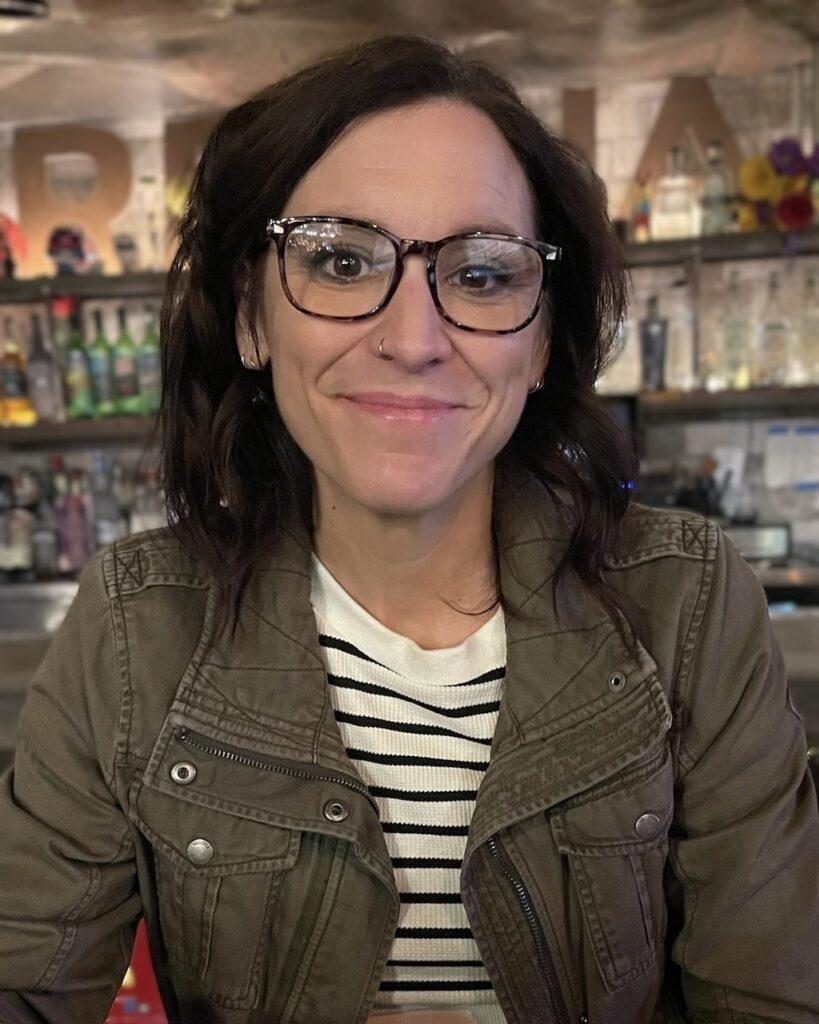
Allison Bothley is a writer and recovering MFA (The New School) who lives in Orangeville, Ontario. Her work has appeared in The Globe and Mail, White Wall Review, Sad Girl Diaries, Literary Review of Canada, and elsewhere. She is the creator and publisher of Bangs Zine, an independent space hot for big feelings, emerging writers, and lazy Sunday readers. Find her @allisonbothleywrites and @bangs_zine